Cryptographic accountability for every AI decision.
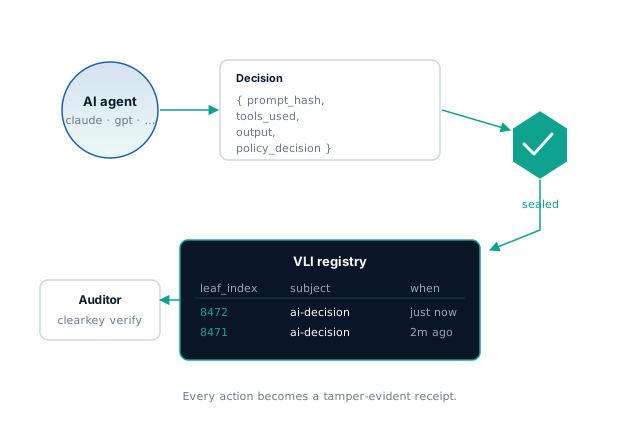
When an AI agent acts on your data, signs a contract, makes a recommendation, or accesses a record — VLI seals what it did, why, and with what context. Every action becomes a tamper-evident receipt your auditors, regulators, and customers can verify forever.
The gap
Three problems VLI solves.
What organizations have today vs. what they'll have tomorrow once every AI action is sealed.
Tomorrow: a sealed record showing which model, what version, what data it saw, what reasoning steps, signed at the moment of decision.
Tomorrow: every agent session begins with
ai_begin_session, every decision sealed, every data access registered. Auditable end-to-end.
Tomorrow: policy is enforced in the seal — a decision either has its required attestations or it doesn't. The math doesn't bend.
Why now
Why this matters now.
Regulators are asking organizations to prove AI systems behaved correctly — EU AI Act, NIST AI RMF, sector-specific rules in healthcare and finance. The proof has to be portable, tamper-evident, and verifiable without trusting the AI vendor.
VLI is that proof layer. It doesn't try to govern what your AI does. It makes what your AI did impossible to deny later.
AI Trust MCP
Six tools. Drop into Claude Code or any agent.
Cryptographic accountability turns on the moment they're registered.
ai_begin_session Start a sealed agent session with an attested identity. ai_seal_decision Record an agent decision, inputs, reasoning, outputs. ai_seal_access Record what data the agent read or wrote. ai_checkpoint Anchor session state at intervals so partial work is provable. ai_end_session Close and seal the session bundle. ai_verify Verify a sealed AI session matches its registered Merkle proof. Session bundle
What a sealed AI session looks like.
Show the session bundle
{
  "session_id":   "ai-sess:abc123...",
  "agent_id":     "did:vli:agent:claude-opus-4-7",
  "started_at":   "2026-04-27T18:00:00Z",
  "ended_at":     "2026-04-27T18:42:13Z",
  "decisions":    47,
  "merkle_root":  "sha256:...",
  "signature":    {"alg": "Ed25519", "value": "sig:..."},
  "registry": {
    "logId":      "verifylinkinfra-prod",
    "leafIndex":  9173,
    "auditPath":  ["sha256:...", "..."]
  }
}
This bundle works in any ClearKey CLI install. No VLI dependency at verification time.
Install
Install + configure
First, mint an AI Trust API key from
the Vault developer console — it'll become your
VLI_API_KEY. Then add to your Claude Code MCP config:
{
  "mcpServers": {
    "ai-trust": {
      "command": "node",
      "args": ["./mcp-ai-trust/src/server.js"],
      "env": {
        "VLI_API_KEY":      "vli_ai_...",   // from /vav/#keys
        "VLI_REGISTRY_URL": "https://verifylinkinfra.com/registry-api",
        "VLI_ART_API":      "https://vliart.com/api",
        "VLI_AGENT_ID":     "your-agent-identity"
      }
    }
  }
}
Source: github.com/VerifyLinkInfra-cloud/mcp-ai-trust · Apache 2.0
Public registry
Looking for the public registry of AI agents?
ART (AI Registry & Trust) is the public-facing companion — a transparency log of AI agents, what they're authorized to do, who delegated that authority, and the trust attestations behind them. Every sealed session via the AI Trust MCP can anchor to ART.
Audience